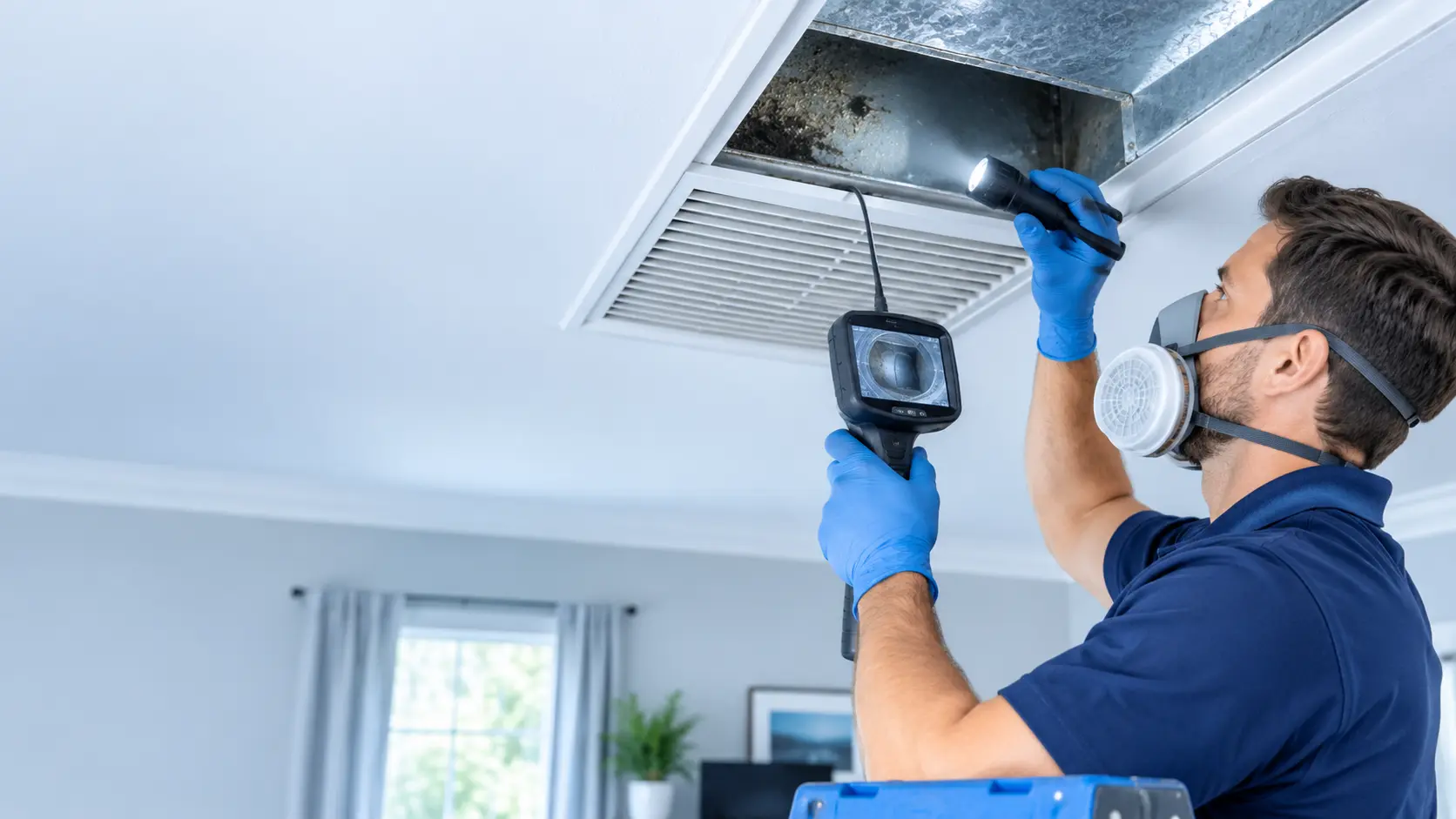
As air ducts are located within walls, ceilings and crawl spaces it can be difficult to see any issues within them until it becomes a problem. Usually you will notice a musty odour or dark spot near an air vent.
This guide will show you signs that you may need air duct mold removal, why you can't visually identify mold, when to call in an expert, and what air duct mold removal entails.
Why Mold Builds Up in Air Ducts
Mold needs some sort of moisture to grow. If there is no moisture then there is nothing for mold to grow on. With an HVAC system you will usually find the following sources of moisture:
- Leaking or dirty coils
- Poor drainage from drain pan
- Water entering the building from leaks or floods
The EPA state that mold will return if the cause isn't resolved. So if you clean a duct but there is an issue with your drain pan constantly overflowing then it's like mopping the floor with a leaking pipe.
So you're looking for signs of moisture.
Signs You May Need Air Duct Mold Removal
Below are signs that you may need air duct mold removal. None of these can definitively identify mold but if you see any of these or have had an incident with water then it's a good idea to have an inspection.
Musty/Rotten Odours When System Is Turned On
Usually the first issue people will notice is a musty/rotten odour. When you turn your heating or AC on there is a musty smell coming through for a few minutes. If you notice this every time you turn on your system then you should check your HVAC equipment.
A smell that shows up as the system starts is a good reason to have the equipment looked at, even if you can't see anything yet.
Visible Mold near Registers, Grilles or Vents
Look at the vent covers and surrounding area. If you notice any dark spots, fluffy patches or discolouration then it's worth taking a picture and noting the date.
Something that looks like mold may turn out to be something else. As mentioned below, this is why an inspection is important.
Moisture/Condensation Near Air Handler, Coils or Drain Pan
If you can access your air handler then look for signs of water, like puddles or damp insulation. Condensation where there shouldn't be any is a warning sign on its own, even if there is no visible mold yet.
Don't try to open up any equipment you aren't comfortable with. Taking pictures from a safe distance is enough to start your conversation with a technician.
Water Damage to Your Property
If there has been a leak from your roof, burst pipes or flooding then water could have gotten into areas near your duct work. Even if you can't see any issues with your vents, if your system has been affected by water or your property has taken on water near the equipment then you should have your ducts checked.
Dust or Debris Coming Through Supply Registers
If you can feel air coming through a register and you're getting dust or debris with it, that's worth taking seriously. It doesn't mean mold, but the EPA list large amounts of dust and debris being released into the home from the supply registers as one of the reasons to consider cleaning.
Why You Can't Visually Identify Mold
It can be easy to see a dark spot and assume it's mold. However you should never panic or ignore it.
The EPA state that whilst it may look like mold you need an expert to identify it. In some cases you may need lab testing to confirm. If any company claims to find mold then ask them to show you.
This is a great way to test any companies you're speaking to. A reputable company will be happy to show you the mold they've found. Ideally they'll have pictures.
By having a proper inspection you'll get an overall answer for your entire system. The inspector will look at your ducts, coils, drain pans and air handler. If your system doesn't need cleaning then this is a great result!
When To Call In An Expert
In some cases you'll want to call in an expert. The EPA state that if there is substantial visible mold growth in hard surface ducts or other parts of the heating and cooling system then you should consider having your ducts cleaned. In reality most people should give us a call if they can see:
- Mold on or near registers
- Musty odours every time system is running
- Property has had a leak/flood near HVAC equipment
- Moving into an old property
- Consistent moisture around coils or drain pans
The EPA also state that duct cleaning shouldn't be done as a regular occurrence. Only when needed. Mold is one of the obvious reasons to clean when needed. However if you have a little dust on your return registers then it's completely normal.
Why It's Rarely a DIY Job
Whilst you can wipe down your vent covers and vacuum the opening there isn't anything you can do to the runs of your ducts, coils or air handler. Coils and drain pans are two of the usual moisture sources, and you can't reach either one.
The EPA state that you should be fully informed before any biocides or sealants are used in your air ducts, so ask what a company plans to use and why.
What Air Duct Mold Removal Entails
Different companies will have different methods but knowing what a thorough clean entails can be helpful. At SaniTech Services on Long Island we follow the ACR standard set by NADCA. We will inspect your system first and if it needs cleaning then we will carry out a full air duct clean. Our process includes:
- Inspection – We will inspect your system and take pictures.
- Containment and Negative Air – We will contain the area and run HEPA filtered negative air machines to trap any loosened material.
- Agitation – We will agitate the surfaces of your ducts using rotary brushes, air whips and skipper lines.
- Full Clean – We will clean your supply and return ducts, inside of your air handler, coils, drain pans, blowers, registers and grilles.
- Finish – We will ensure all access points are properly closed and your components are in a working condition. We will also provide you with before and after pictures and a written report.
The pictures and the written report give you a record of what was found and what was done.
If during our inspection we find your coils need attention then we offer a coil clean. If we find sections that are leaking then we can also carry out duct sealing.
What Can't Be Cleaned
A good company will let you know what can't be cleaned. If:
- Active moisture – There is active moisture leaking from your coils, drain pans or roof then this will need fixing first. Otherwise you'll have paid twice to do the same job.
- Insulated ducts are wet/moldy – The EPA state that if your insulated ducts are wet or mouldy then they can't be effectively cleaned and need replacing. Any company claiming they can clean mouldy insulation to a like new condition are over promising.
- Mold on your walls, ceilings or other occupied areas not caused by your HVAC system – This is a building issue and not something that can be fixed by cleaning your ducts. This will need a different type of expert.
Large Scale Mold Jobs in New York
In New York any mold work over a certain scale is regulated. Anything over 10 square feet of mold remediation or assessment must be performed by a licensed mold professional. If your property falls into this category then your duct cleaning company should clearly state this. You can search for licensed mold contractors on the NYS Department of Labor website.
Residential Properties
Most residential properties will have one or two air handlers. A typical residential clean will take between 3-5 hours. Most people will call us due to leaks/flooding, renovation dust, noticing debris coming through registers or buying an older property.
Commercial Properties
Larger properties will have multiple air handlers and rooftop units. We will usually work around your timescales and will work at night, weekends or during breaks. We will contain the area to ensure no dust gets to your staff/tenants. We will provide written reports for your facility management and insurer. If you manage a building then visit our commercial duct cleaning page to learn more.
What To Do If You Think You Have Mold
Don't try to fix everything in one afternoon. A logical process would be:
- Look for the source of the moisture.
- Take pictures of any visible issues with your registers/vents and around your equipment. Note the date.
- Book an inspection before any cleaning is done.
- Ask to see the mold. If they claim to have found mold they should be able to show you.
- Get it in writing. Know what will be cleaned, how and what won't be cleaned.
If any members of your household are suffering from symptoms you think may be related to your home environment then speak to your doctor.
Finding The Right Company
Not all duct cleaners will do the same. Look for companies who will do an inspection, explain what they will do and are happy to tell you if they don't need to clean. Ask about certifications and written reports. At SaniTech Services we are NADCA members. Our specialists are ASCS certified and we have a Certified Ventilation Inspector.
Our guide to choosing a NADCA certified duct cleaner outlines what questions to ask. We serve Nassau County, Suffolk County and all 5 Boroughs of NYC.
FAQs
How do I know if I have mold in my air ducts?
Typically you will notice a musty odour, visible mold or history of water damage. However you can't confirm it's mold without an inspection. Sometimes you will need lab testing to confirm if it's mold or something that looks like mold.
Can it be cleaned?
Often yes. The EPA state that if there is significant visible mold growth within hard surface ducts then you should consider cleaning. If your insulated ducts are mouldy then they will usually need replacing. Any issues with moisture will need fixing otherwise the mold is likely to return.
Is it safe to clean mold out of my ducts?
Whilst you can wipe visible surfaces near your register you won't be able to clean most of the system. The coil and the inside of your air handler are out of reach with household tools. The EPA also say to be fully informed before biocides or sealants go into your ducts. If there is more than a visible spot near your vent then start with having an inspection.
Does a musty odour mean there's mold in my ducts?
Not by itself. A musty odour is one of the common signs, but it doesn't confirm mold. An inspection will tell you whether the source is in your HVAC system.
How much does air duct mold removal cost?
The price will depend on the size of your system, how accessible it is and what we find during our inspection. We offer free no obligation quotes and will get everything in writing.
Speak To An Expert
If you've noticed a musty odour, visible mold or water damage near your HVAC system then we can give you an inspection to tell you what's going on. Give us a call on (631) 656-3315 or request a quote. Let us know what you've noticed, what type of property you have and if there has been any water damage.
Need Professional Help?
Get a free, no-obligation quote from our NADCA-certified team.
Get a Free Quote