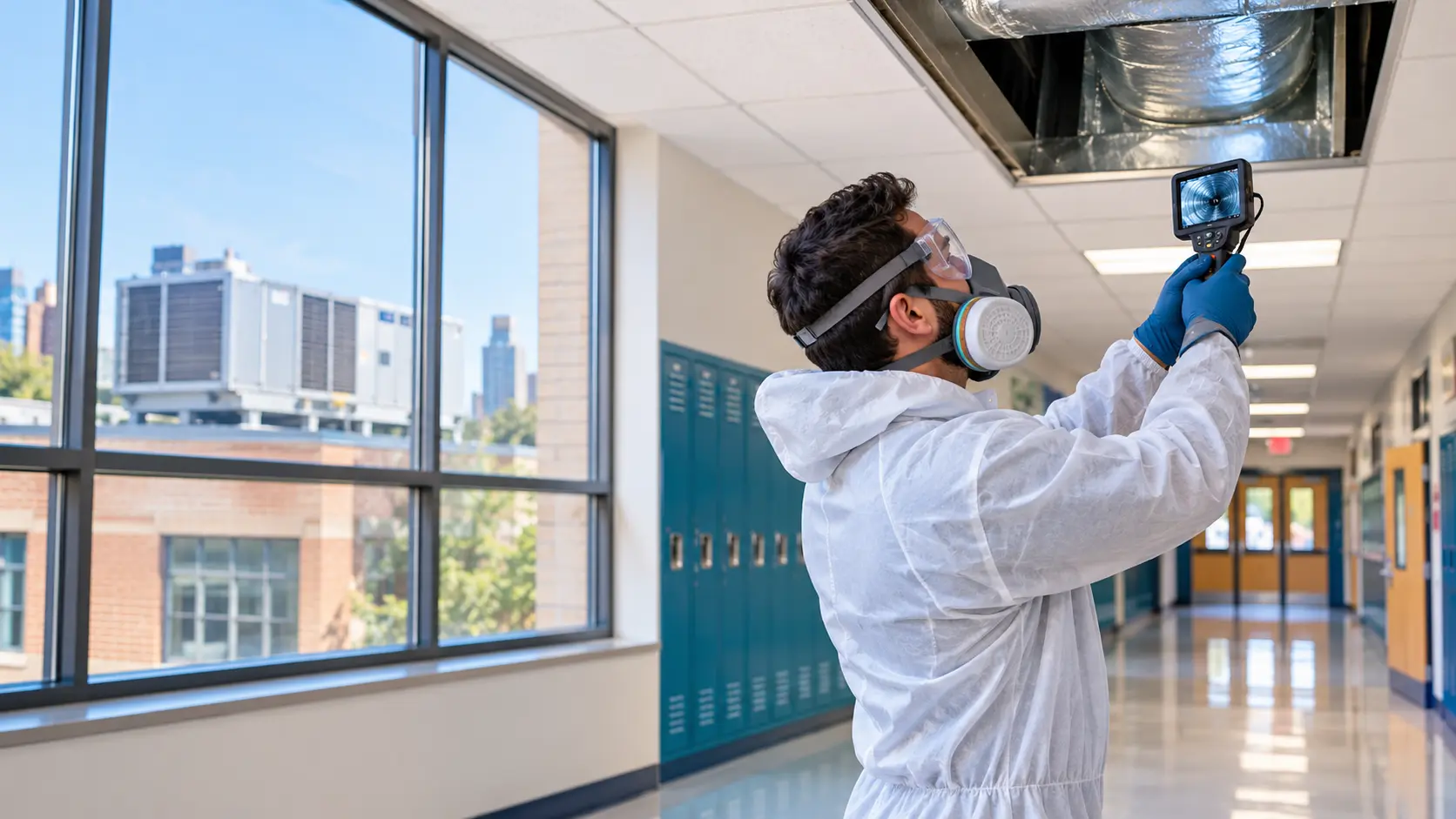
Think about what a school building takes in all day. Hundreds of kids, seven or eight hours, wet coats in January, chalk and marker dust, paper, grit tracked in from the gym. Plenty of that ends up inside the HVAC system, and nobody sees it.
If you run facilities for a school in the city or out on Long Island, you've heard the complaints: stuffy classrooms, dusty vents, a gym that smells off by March. None of this is new. In 2020 the city's teachers union said air quality drew more member complaints than any other health and safety issue, and reporting from that period found that fewer than half of the city's roughly 1,500 school buildings had full HVAC systems at all. The numbers are old now. The problem isn't.
Lawmakers have noticed too. A bill in Albany (A.7586/S.7733) would push schools toward HVAC assessments, and Intro 699 in the City Council would require air quality reporting for schools. Both are proposals, though, and proposals move. Check where they stand before you quote either one to a board.
This is written for whoever has to hire the duct cleaner: facilities directors, business managers, principals, custodial engineers, and the contractors bidding against us. We'll cover what cleaning can and can't do, why certification counts in a school, what public bids usually ask for, and how to read a quote without getting burned.
What Duct Cleaning Actually Does
First, the honest version, since it'll spare you a few bad sales pitches. The EPA has said for years that studies haven't conclusively shown that dirty ducts make people sick. It suggests cleaning when there's visible mold, a vermin problem, or ducts so clogged that debris is blowing into occupied rooms. NADCA, the industry association, wants that decision made from an inspection, not a calendar.
Cleaning also won't rescue a school with bad ventilation. If the real culprit is a stuck damper, a blocked outdoor air intake or filters nobody changes, scrubbing the ducts changes very little.
Where it does pay off: after construction or a renovation, after water damage, when an inspection finds mold or heavy debris, and in older buildings with decades of dust packed in. It's also worth doing when restricted airflow has the equipment straining. (If the airflow problem starts at the equipment, dirty AC coils are a separate job worth ruling out.)
A good contractor starts by telling you what you don't need. If someone quotes a full cleaning without ever looking inside the system, keep shopping.
What SCA Certification Tells You
The School Construction Authority builds and maintains a big share of New York City's public schools, and contractors who work in those buildings answer to a tougher bar than someone cleaning an office suite. We're SCA certified for duct cleaning in NYC public schools. In practice, that approval tells a school or a general contractor that we've already been vetted for city school work, so they aren't starting from zero when they decide whether to trust us on site.
It doesn't replace the technical credentials, and you shouldn't take it on faith, ours included. The SCA sets its own requirements and changes them, so ask any contractor for current paperwork and confirm it with the agency.
The credentials underneath
Public duct cleaning bids in New York tend to lean on two things from the NADCA world: company membership, and ASCS (Air Systems Cleaning Specialist) certification for whoever supervises the job.
Here's one upstate town's bid package. It asked for a NADCA member in good standing, a project supervisor with a current ASCS certification, proof of both with the bid, and registration with the NYS Department of Labor. The state's own master specification for HVAC cleaning goes further and asks for the firm's NADCA certification, the supervisor's qualifications, and five similar projects from the past ten years.
Two documents don't make a rule, and your district will have its own paperwork. But the pattern holds up well enough that if a contractor can't produce NADCA membership, an ASCS supervisor and a project list, you're entitled to ask why.
What the ACR standard covers
NADCA publishes ACR, the standard for assessing, cleaning and restoring HVAC systems. The 2025 edition came out in October 2025 and is a free download. It covers how to inspect a system, how to clean it, how to hold the right pressure while the work is going on, and how to check that it's actually clean afterward. If a contractor says they follow the standard, ask which edition, and ask to see how they document it. We follow ACR from assessment through post-cleaning verification, and every project ends with before and after photos, compliance paperwork and maintenance recommendations.
Source removal first, chemicals second
NADCA has urged contractors against treating chemicals as a cleaning method and pushes physical source removal instead. In a school that matters. An antimicrobial sprayed into a dirty duct is cosmetic at best. If a contractor offers sanitizing, it should come after the system is physically clean, and it should be your call, not a line item you never asked about.
Nine Questions to Ask Before You Hire a Duct Cleaner
Bring these to every walkthrough. The answers matter, but so does how quickly and clearly someone gives them.
- Can I see your current NADCA membership and the ASCS certificate for the person who will supervise my job?
- Are you approved to work in city school buildings, and can I verify that with the agency myself?
- Will you inspect the system first and give me a written scope, or are you quoting from square footage?
- Which parts of the system are included: supply and return ducts, plenums, coils, blowers, air handlers, registers, bathroom exhausts?
- How will you contain dust and keep the right pressure while you work?
- What do I get at the end? Look for before and after photos, a written report and any compliance certificates.
- What happens if you find fiberglass lined duct, mold or damage you didn't expect? Who decides, and what does it cost?
- When can you actually work: summer break, weekends, evenings, school vacation weeks?
- If the post-cleaning check fails, what's your re-clean policy?
What a well run job looks like
Walk the system with the contractor before anything starts. They should open access points, look inside with a camera or just their eyes, and write down what they see: fiberglass lining, moisture stains, damaged sections.
While the work is going on, the section being cleaned sits under negative pressure, so dust gets pulled toward the collection equipment and not into the classroom. Technicians knock debris loose with agitation tools and capture it with HEPA filtered vacuums. Coils, blowers and air handlers get cleaned too. A spotless duct feeding a dirty coil doesn't get you very far. You can see how we approach this on our HVAC air duct cleaning page.
Afterward the contractor checks the result against the standard, takes photos and hands you a report. If you can, walk the building with them again. Seeing the inside of a clean duct yourself beats any certificate.
Why quotes for the same building can be far apart
Two quotes for the same school can sit thousands of dollars apart, and the cheaper one usually covers less. Price follows the number of air handling units, total duct length, access, ceiling height, insulation type, and how much of the work has to happen after hours. A low number that only covers visible grilles isn't a bargain. Lay the scopes next to each other and compare them line by line before you glance at the total. Our buyer's guide to commercial duct cleaning walks through what a complete scope should include.
Flat rate pricing needs a warning. Residential coupons ("whole house for $X") are all over Long Island, and none of that carries over to a school or commercial system. If someone quotes your building the way they'd quote a ranch house, take note.
When to schedule
Summer break is the obvious window, and every good contractor knows it, so they fill up. Bid in spring if you can. Winter and spring recess and long weekends suit smaller jobs or a single wing. Get the schedule in writing and check that it fits around your custodial crew, testing days and any permits.
Red flags
Scare talk about "toxic mold" before anyone has looked inside the system. No inspection. Credentials you can't verify. A contractor who can't name similar projects. A pitch built on chemicals instead of physical cleaning. Any one of these is reason enough to move on.
Working With SaniTech
SaniTech Services has cleaned commercial and institutional HVAC systems from our Hauppauge, NY office since 2011. We're a NADCA member with ASCS-certified specialists, and we hold NYC SCA and WBE certifications.
For a school or commercial building we start with an inspection and a written scope, so the quote matches your actual system and not a guess. Call (631) 656-3315 or request a free quote.
FAQs
How often should a school have its air ducts cleaned?
No single number fits every building. NADCA's approach is to decide from an inspection, and a lot of facilities teams settle into a yearly visual check with a closer review every few years. A building with recent construction, past water damage or heavy dust may need cleaning sooner.
How much does commercial duct cleaning cost?
It depends on the system more than the square footage. Air handling units, duct length, access, insulation and working hours all move the price. A fair quote starts with an inspection and a written scope, and anyone who gives you a firm number sight unseen is guessing.
Does duct cleaning help students with asthma or allergies?
Sometimes, but not on its own. If the ducts really are contaminated, cleaning takes away a source of dust and debris. The EPA, though, hasn't found conclusive proof that duct cleaning by itself prevents health problems. Filtration, ventilation, moisture control and routine maintenance matter more. The Asthma and Allergy Foundation of America has backed New York legislation requiring HVAC assessments in schools, which tells you the whole system is the target, not just the ducts.
Is duct cleaning the same as improving ventilation?
No. Cleaning removes built up debris. Ventilation is about how much outdoor air comes in and how air moves through a room. A school can have clean ducts and poor ventilation, or the other way around. A good contractor will say so if your real problem is outside the ductwork.
What's the difference between a NADCA member and an ASCS certified technician?
The company holds NADCA membership. ASCS (Air Systems Cleaning Specialist) belongs to an individual. Ask for both, and ask which ASCS holder will actually be on your site. We're a NADCA member with ASCS certified specialists.
Does a school need an antimicrobial treatment after cleaning?
Not by default. Physical cleaning comes first. An antimicrobial application makes sense when there's a specific concern, like a past moisture problem, and it should use an EPA registered product applied the way the label says. If someone pitches it as a standard add-on without saying why, ask.
What about gyms and locker rooms?
Athletic spaces have a different problem from duct dust: sweat, moisture and shared equipment. Our Surface Antimicrobial Solutions program covers locker rooms, training areas and mats, and we've treated NCAA wrestling facilities at Hofstra and Columbia. If your school has a busy gym, ask about surface sanitation alongside the ductwork.
Can duct cleaning happen while students are in the building?
Sometimes, yes: in sections, with containment, usually after hours. Most schools pick summer, winter or spring break because there's far less to coordinate. Bring it up at the walkthrough so the contractor can plan around occupied spaces.
What should a duct cleaning report include?
Before and after photos, the areas and components cleaned, anything odd found along the way, and follow-up recommendations. File it with your maintenance records.
Are there new air quality rules for New York schools?
Proposals have been moving through Albany and the City Council on HVAC assessments, air quality monitoring and public reporting. We wouldn't call any of them settled until you've checked the bill status on the official legislature site.
Need Professional Help?
Get a free, no-obligation quote from our NADCA-certified team.
Get a Free Quote