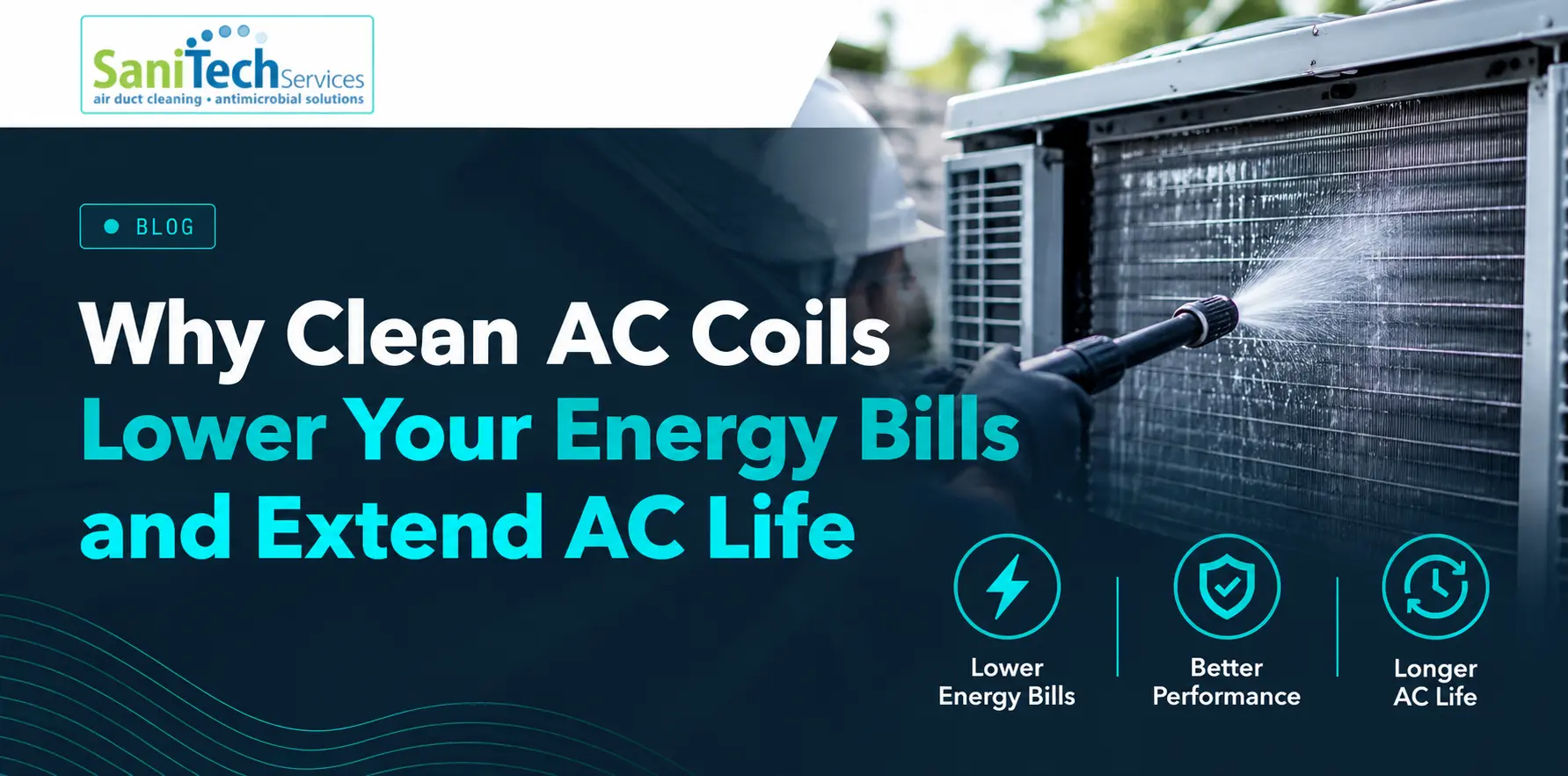
Picture a hot July afternoon. The AC has been running since morning, the thermostat says 72, and the room still feels like 78. Most people blame the thermostat. Some start googling compressor prices. Hardly anyone checks the coils, which is a shame, because that's where the trouble usually starts. If you clean AC coils on a regular basis, the whole system stops fighting itself.
Here's what's happening. Coils are where the cooling actually takes place. Cover them in dust and pollen and the system has to work much longer to get the same result. You pay for that in electricity now and in repairs later.
We'll go through how it works, how to tell if your coils are dirty, how often to deal with them, and what's safe to do yourself. Most of this is about homes, with a note here and there on commercial buildings, because that's the bulk of our day job.
What AC Coils Actually Do
Quick science lesson, and we'll keep it short. An air conditioner doesn't make cold air. It moves heat out of your space and dumps it outside. Two coils do the moving.
The evaporator coil (indoors)
This one lives inside the air handler or furnace. Warm room air blows across it, and the refrigerant inside soaks up the heat. It also pulls water out of the air, which is why there's a drain pan underneath and a line that carries the water away.
The condenser coil (outdoors)
This is the radiator-looking part of the outdoor unit, or the rooftop unit on a commercial building. Its job is to get rid of all that heat. A fan drags outdoor air through the fins and carries it off.
Both coils rely on clean fins and open airflow. Block either one and the whole process slows down. Think of running a marathon in a parka.
Where the Dirt Comes From
Coils don't get filthy overnight. It's slow, and it's mostly stuff you'd never notice day to day.
- Weak or missing filters, so dust sails right past and sticks to the indoor coil
- Leaky return ducts that suck in dust from attics and ceiling spaces
- Pollen, cottonwood fluff, and grass clippings on the outdoor unit
- Construction next door (drywall dust gets everywhere)
- Humidity, which turns loose dust into a sticky film that's much harder to get off
The indoor coil is the one everybody forgets, because it's tucked away where you can't see it. It's also where the worst buildup likes to hide. The best defense is boring: a decent filter, swapped on time. Just don't assume a higher rating is always better. Some systems struggle to pull air through a very dense filter, so check what yours was built for.
How Dirty Coils Drive Up Your Energy Bill
Dirt works like a blanket on a coil. Even a thin layer slows down the heat moving between the air and the refrigerant. A thick mat can block airflow almost completely.
The AC doesn't just quit, of course. It tries harder. The compressor and fans run longer to reach the temperature you asked for, and longer run times mean more kilowatt-hours. In summer, cooling is often one of the biggest lines on a power bill, so that adds up fast.
You'll find big savings percentages all over the internet. Be skeptical. The real number depends on how dirty the coils are, how old the equipment is, and how hard it works. What never changes is the direction. Clean coils mean less runtime.
A system with dirty coils tends to do all of this at once:
- Cools slowly, because heat transfer is weak
- Pushes less air, so some rooms get shortchanged
- Cycles on more often and stays on longer
- Makes fans and motors work against extra resistance
- Runs the outdoor unit hotter, with higher pressure inside
How Clean AC Coils Extend the Life of Your System
The bill is what you notice. The wear and tear is what bites you later.
The compressor takes the hit
The compressor is the heart of the system, and usually the priciest part to replace. If a dirty condenser can't shed heat, temperature and pressure climb inside. Compressors hate running hot. Make them do it for a few summers and you've cut years off their life.
Frozen evaporator coils
Here's a common one. A clogged filter or a dirty evaporator coil chokes the airflow, the coil gets too cold, and ice builds up. Ice blocks even more air. Then it melts, the drain pan overflows, and you've got water stains on the ceiling to go with a warm office.
Corrosion and leaks
Damp dirt that sits on a coil for months is an open invitation to corrosion. Eventually that can mean tiny refrigerant leaks, and replacing a coil is rarely cheap.
People often say an AC lasts 15 to 20 years. How close you get depends a lot on upkeep. Clean coils won't save a unit that was bad from the start. They do remove one of the most common reasons good units die early.
Signs Your Coils Need Cleaning
Most systems drop hints before they fail. Keep an eye out for these:
- Your bill goes up and nothing about how you use the building changed
- Weak airflow at the vents
- The AC runs nonstop, or close to it
- One room is fine and another is an oven
- Ice on the refrigerant lines or the indoor coil
- Water around the air handler
- A musty smell when the AC starts up
- An outdoor unit that looks like it's wearing a fur coat of cottonwood, grass, and dust
- The outdoor unit shuts off or trips the breaker on the hottest days
Of course, one symptom alone doesn't prove it's the coils. A weak capacitor or low refrigerant can look almost the same. Before you spend money, get a proper HVAC system inspection. A good one looks at the coils, filters, drain lines, and airflow together, so you find the real problem instead of guessing.
How Often Should You Clean AC Coils?
No single answer fits everybody. This is a fair starting point.
- Outdoor coil: look at it every spring before cooling season starts, and clean it if it's dirty. Trees, construction, or salty coastal air mean checking more often.
- Indoor coil: inspect it at least once a year. Good filters and on-time filter changes stretch the time between cleanings.
- Commercial systems: they run longer hours and move more air, so they get dirty faster. Let inspection findings set the schedule.
For buildings, we like to let the inspection decide. NADCA's approach is regular inspections at intervals that suit the building, with cleaning when the findings call for it. Our guide on how often commercial HVAC systems should be cleaned covers that in more detail.
What You Can Do Yourself (and What to Leave Alone)
Safe, easy jobs
- Change your filter on schedule. Every one to three months is typical, but follow the manufacturer's advice and go sooner in dusty spaces.
- Give the outdoor unit room to breathe. A couple of feet of clear space, no weeds, no piled-up leaves.
- Kill the power at the disconnect, then rinse the outside fins gently with a garden hose. Low pressure. Always.
Better left to a pro
- The indoor evaporator coil (it's behind panels, close to wiring and refrigerant lines)
- Heavy, caked-on buildup between the fins
- Bent or flattened fins
- Anything that needs a coil-safe cleaner, since a harsh acidic product can eat aluminum and copper
- Units with ice, leaks, or a musty smell that keeps coming back
Pressure washers and kitchen cleaners do more harm than dirt ever will. The fins are paper thin. Bend them and you've blocked the air all over again.
What Professional Coil Cleaning Looks Like
Every job is a little different, but a solid visit goes something like this:
- Shut the power off, lock it out, and inspect the coils, filters, and drain pan
- Pull the access panels and cover nearby wiring and insulation
- Apply a coil-safe cleaner matched to the coil material and give it time to work
- Rinse the loosened dirt out, aiming the water so it doesn't push grime deeper into the fins
- Clean the drain pan and clear the condensate line
- Straighten bent fins with a fin comb
- Put everything back, restart the system, and confirm airflow and cooling are normal
Don't skip the drain pan. Leave it slimy and you can still end up with clogs and leaks, even after a flawless coil cleaning.
Why Coils Matter Even More in Commercial Buildings
In an office, school, or clinic, there's more riding on it. Rooftop units and air handlers run long hours, sometimes all day. One unit losing a bit of efficiency is annoying. Several units losing it for a whole cooling season is a real cost. And when a unit gives up in July, you get hot tenants and rush repair calls.
Work in an occupied building also has to fit around people. Roof access, tenant schedules, who has the mechanical room key. It usually pays to bundle everything into one planned visit: coils, filters, drain pans, and the ducts they feed. If the ductwork is dirty too, pairing coil work with HVAC air duct cleaning can mean fewer disruptions for everyone in the building.
Working With SaniTech
SaniTech Services has cleaned commercial and institutional HVAC systems from our Hauppauge, NY office since 2011. We're a NADCA member with ASCS-certified specialists, and we hold NYC SCA and WBE certifications.
If your system is struggling, call (631) 656-3315 or request a free quote. We'll look at the equipment first and tell you what it really needs.
FAQs
How often should I clean AC coils?
Check the outdoor coil every spring and clean it if it's dirty. Look at the indoor coil at least once a year. Heavy dust, pets, construction, or coastal air mean you'll want to check more often. For buildings, let a professional inspection set the schedule.
How much can clean coils save on my energy bill?
It depends on how dirty the coils are and how hard the system works. Lightly dirty coils may only make a small difference. Heavily clogged ones can add a lot of runtime. Be wary of anyone promising an exact percentage. Comparing your own bills before and after cleaning is a more honest test.
Can I clean AC coils myself?
Partly. Rinsing the outdoor unit gently with a garden hose, after cutting the power, is a reasonable maintenance task. The indoor coil and heavy buildup are better left to a professional, because of the wiring, the drain pan, and those delicate fins.
Will cleaning fix an AC that blows warm air?
Sometimes. If dirt is the cause, cleaning can bring performance back. But warm air also comes from low refrigerant, failed capacitors, and compressor trouble. Get the system inspected first so you know what you're actually fixing.
Is coil cleaning the same as duct cleaning?
No. Coils are the heat transfer parts inside the equipment. Ducts are the passages that carry the air around the building. They're separate jobs, though it often makes sense to plan them together.
Need Professional Help?
Get a free, no-obligation quote from our NADCA-certified team.
Get a Free Quote