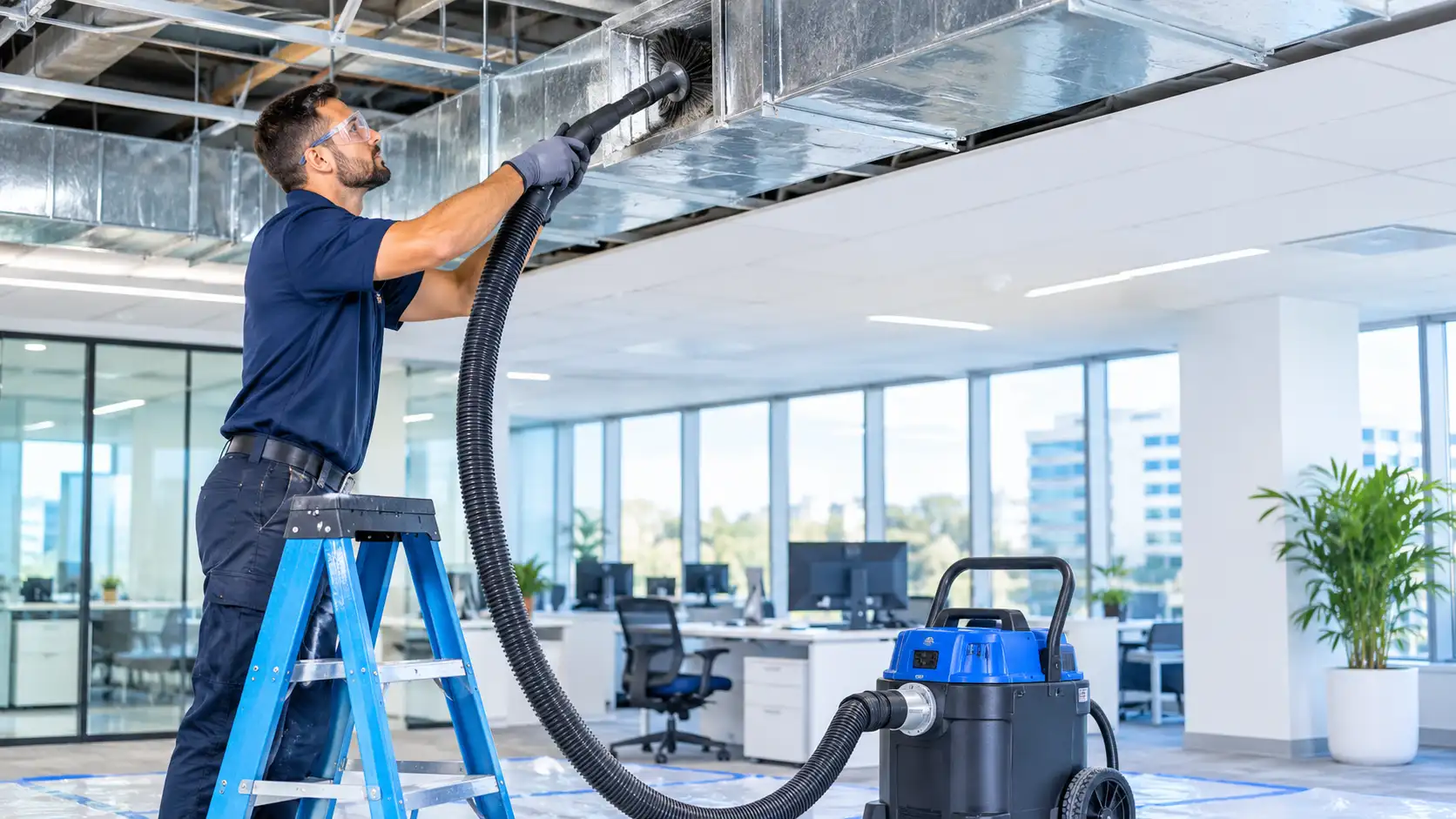
Ask a few facility managers how often their ducts get cleaned and the answers rarely match. One says every year. Another says never, because nobody has complained. Neither answer rests on much.
The reality is that commercial duct cleaning doesn't run on a fixed calendar. It depends on what the building is used for, how many people are inside, how well the filters are kept up, and what an actual inspection turns up.
Short answer: Commercial HVAC ducts should be cleaned when an inspection shows dust buildup, mold, pest activity, or restricted airflow, not on a set schedule. Most buildings benefit from regular inspections. The right cleaning interval depends on occupancy, building type, filtration, and moisture. Healthcare, schools, and food service spaces usually need closer attention.
Key Takeaways
- There is no single cleaning interval that fits every commercial building.
- Regular inspections tell you more than a calendar reminder does.
- Visible mold, pests, debris at the registers, or weak airflow are reasons to schedule cleaning now.
- Building type, occupancy, and construction work all change how fast ducts get dirty.
- Ask for before and after documentation, and hire a NADCA member with trained specialists.
What Decides How Often Commercial Ducts Need Cleaning?
Four things matter most: how the building is used, how many people occupy it, how the system is maintained, and what is happening around it. A busy medical office and a quiet storage unit with one small HVAC unit will not collect dust at the same pace.
Here are the factors we'd look at first:
- Occupancy. More people means more skin cells, fibers, and outside dust carried in on shoes and clothes.
- Filtration. Filters that are changed on time keep a lot of material out of the ducts. Neglected filters let it through.
- Moisture. Leaks, condensation, and humid summers on Long Island and in New York City can create damp spots in or near ductwork.
- Construction. Renovations, tenant build-outs, and demolition release fine dust that can enter open returns.
- Pests. Rodents and insects sometimes nest in ducts, especially where there are gaps or disconnected sections.
- System age and condition. Older systems may have more leaks and more places for debris to settle.
Is There a Standard Cleaning Schedule for Commercial Buildings?
No. Most guidance for homes, including the U.S. Environmental Protection Agency's, says duct cleaning isn't something to do on a routine basis. It makes sense when there is visible mold, a pest problem, or heavy buildup that is blowing out of the supply vents.
That logic holds for commercial properties too. The difference is that more people share the air in an office, school, or clinic, so it's smart to look more often.
A yearly visual inspection is a reasonable habit for many buildings [VERIFY: confirm SaniTech's recommended inspection interval before publishing]. Cleaning then follows what the inspection finds. If the ducts look clean and airflow is steady, you can skip a cleaning and save the budget. If they don't, you'll have photos and notes to justify the work.
How Does Building Type Affect Duct Cleaning Frequency?
The same system behaves differently depending on who uses the space. The table below shows what tends to push a building toward closer attention.
| Building type | What to watch for |
|---|---|
| Office buildings | Occupancy changes, tenant build-outs, filter upkeep |
| Medical and healthcare facilities | Air quality expectations, patient sensitivity, strict cleanliness standards |
| Schools and daycares | High occupancy, seasonal use, humidity during breaks |
| Restaurants and food service | Grease in kitchen exhaust, odors traveling into dining areas |
| Retail and shopping centers | Foot traffic, frequent door openings, outdoor dust |
| Warehouses and industrial spaces | Airborne particles, equipment dust, limited filtration |
Healthcare, schools, and offices
Spaces with sensitive occupants deserve a shorter leash. If people with asthma, allergies, or weakened immune systems spend time in the building, regular inspections matter more. The same goes for schools, where large groups share the same air for hours.
Offices sit in the middle. Many are fine with periodic inspections, as long as filters are changed on time and nobody has reported musty smells or poor airflow.
Restaurants and food service
A commercial kitchen has its own exhaust hood and duct system, and that system is handled separately from your supply and return ducts. Grease buildup there is a fire concern, which is why kitchen exhaust system inspections are tied to fire code. Don't assume that cleaning one covers the other.
How Do You Know When Commercial Ducts Need Cleaning?
You'll usually spot warning signs before the system fails. If you see any of the following, schedule an inspection rather than waiting for the next planned visit.
- Dust or debris collecting around supply registers and return grilles
- Visible mold on or near ducts, vents, or air handlers
- Musty or stale smells when the system starts
- Evidence of rodents or insects, such as droppings or nesting material
- Uneven temperatures between zones
- Weak airflow at registers that used to work well
- Tenant or staff complaints about air quality or allergy symptoms
- Recent renovation or demolition work
One thing to be careful about: if someone says there is mold in your ducts, ask them to show you. A reputable contractor will point to what they found, explain what it means, and tell you plainly when cleaning isn't needed.
Why Is Inspecting Better Than Cleaning on a Schedule?
An inspection shows the actual condition of your ducts, while a calendar only shows that time has passed. Inspecting first means you clean when it's needed and skip it when it isn't.
Two buildings of the same age can have very different ducts. One might have a tight system with good filters and little traffic. The other might have leaks, a busy lobby, and a renovation every couple of years.
Written inspection notes and photos also build a history. After a few years, you can see how quickly dust returns in your building and plan around it. That record helps when you explain a budget request to an owner or a property manager, and it gives tenants a straight answer when they ask about air quality.
What Does a Commercial Duct Cleaning Visit Involve?
A proper visit follows a set process. Details vary by system, but a typical job runs like this:
- Inspection and scoping. A technician looks at the air handlers, ductwork, and registers, then writes up what needs to be cleaned.
- Access and protection. Access points are opened where needed, and the work area is protected so dust doesn't spread into occupied rooms.
- Negative pressure. A high-powered vacuum creates suction in the duct system so loosened debris is pulled into a collection unit instead of drifting into the building.
- Agitation and cleaning. Brushes, air tools, or similar equipment loosen buildup from duct surfaces while the vacuum captures it.
- Components. Registers, grilles, and accessible parts of the air handling equipment are cleaned as part of the scope.
- Closing and documentation. Access points are sealed, and the crew provides before and after records, such as photos.
If the technician notices loose joints, gaps, or damaged duct sections, they should tell you. In that case, duct sealing may be a better next step than more cleaning.
How Long Does Commercial Duct Cleaning Take?
It depends on the size of the system, how easy the ducts are to reach, and how dirty they are. A small suite is not the same job as a multi-floor building with several air handlers.
Many commercial jobs are scheduled after hours or in sections so staff, tenants, and customers aren't disrupted. Ask for a written scope and timeline before work begins.
Does Cleaning Ducts Improve Air Quality and Energy Use?
Sometimes, yes, though it's not a cure-all. Dust and debris can restrict airflow, and restricted airflow makes the equipment work harder. Cleaning removes that obstruction.
But cleaning alone won't fix leaks, poor ventilation, or worn-out equipment. Coil cleaning, filter changes, and a full HVAC system inspection often belong in the same conversation. A technician who looks at the whole system will give you a more honest picture than one who only offers to clean the ducts.
Who Should Handle Commercial Duct Cleaning?
Look for a contractor with real credentials. Membership in the National Air Duct Cleaners Association (NADCA) is a good sign, and so is a crew that includes trained specialists, such as people holding the Air Systems Cleaning Specialist (ASCS) certification.
Before you hire anyone, ask these questions:
- What is included in the written scope?
- What equipment will you use, and how do you contain dust?
- How will you protect occupied areas?
- Will I get before and after documentation?
- Will you tell me if cleaning isn't needed?
SaniTech Services is based in Hauppauge, New York. It serves Nassau County, Suffolk County, and all five boroughs of New York City. The team is a NADCA member with ASCS-certified specialists.
Mistakes That Waste Money
A few habits cost building owners more than they should:
- Cleaning on a calendar instead of when inspections say it's needed
- Skipping filter changes, then paying to clean the ducts they should have protected
- Cleaning ducts while ignoring leaks or moisture that will bring the dust right back
- Hiring on price alone without checking the scope or credentials
- Forgetting to get documentation, so there is no record of the work
FAQs
How often should commercial HVAC ducts be cleaned?
There is no one-size schedule. Ducts should be cleaned when inspection shows buildup, mold, pests, or restricted airflow. Many buildings benefit from regular inspections, and healthcare, schools, and food service spaces usually need closer attention. Occupancy, filtration, moisture, and nearby construction all affect how quickly ducts get dirty.
Is commercial duct cleaning worth it?
It can be when there is a real problem, such as visible debris, mold, pests, odors, or airflow complaints. If an inspection shows clean ducts and steady performance, cleaning may not be needed. A written inspection report helps you decide and gives you a record whichever way you go.
Can ducts be cleaned while the building is occupied?
Often, yes, with planning. Many commercial jobs are scheduled after hours or done in sections, and dust is contained with negative pressure equipment. The right approach depends on the layout, tenant needs, and which areas are in use. Ask your contractor to explain the plan before the work starts.
What is the difference between duct cleaning and kitchen exhaust cleaning?
Duct cleaning covers the supply and return air system that heats and cools the building. Kitchen exhaust cleaning deals with the hood and exhaust ductwork above cooking equipment, where grease collects. They are separate systems with different risks, and fire codes govern kitchen exhaust, so one service does not replace the other.
Do I need duct cleaning after construction or renovation?
Often it's worth an inspection. Construction and demolition release fine dust that can enter open returns and settle in ducts. If you see debris at registers or notice poor airflow after the work, cleaning may be needed. Covering returns during construction helps prevent the problem in the first place.
Commercial Duct Cleaning: A Practical Place to Start
If you can't remember when your ducts were last inspected, start there. An inspection tells you what's going on, and it gives you the information to decide whether cleaning, sealing, or no action at all is the right call.
When you want a professional opinion, the SaniTech Services team offers free quotes with no obligation. Call (631) 656-3315 or request a quote online and ask about commercial duct cleaning for your property.
Need Professional Help?
Get a free, no-obligation quote from our NADCA-certified team.
Get a Free Quote